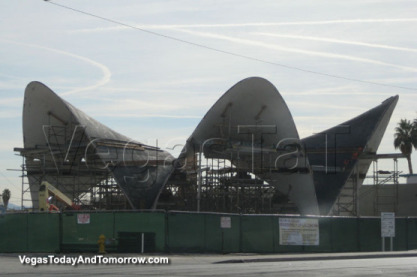
Moulin Rouge may be coming back to life!


Moulin%20Rouge.jpg 


In all the hubbub of last week, we forgot to shine the spotlight on this very important news.

According to an article in the Las Vegas Review Journal , out-of-town investors have partnered with the local Moulin Rouge Development Corp. to revitalize the once-proud hotel/casino on Bonanza Road.

The Moulin Rouge, of course, was the first segregated hotel in Las Vegas and opened on the Westside in 1955.  It quickly became the 'in' spot with its dance troupe from the famed Cotton Club in New York and a nightly list of entertainment that kept the joint jumping until the early hours of the morning.  

Despite its seeming success, the hotel closed abruptly months later.  Despite many different efforts to re-open the fabled casino and showroom, for too many years the property sat empty and forlorn.  In 2003, work began on restoring the casino and the showroom.  Unfortunately, in 2004, an arson fire gutted all but the front wall and Betty Willis' iconic sign.

That serious money is being invested with a look towards rebuilding and restoring the Moulin Rouge is great news.  We hope this time it comes to pass.

To read the article, click here

The La Concha and the Las Vegas Neon Museum

La%20Concha%20today.jpg


As we noted a few weeks back in our Historic Site of the Week, the La Concha is being pieced back together so that it can serve as the lobby and gift shop for the Neon Museum.

Kristen Peterson, in today's Las Vegas Sun brings us up to date on the progress.:

"But after all these years of bulldozing our history, neglecting the unique architecture, something had to give. That something was this conch-inspired structure that served as the entrance to La Concha Motel, built when 5,000-room hotels weren’t even part of the discussion.

Neon was our visual commodity then. We were the first midcentury modern city. A city with no past. No 19th-century concert halls or skyscrapers to define us. No vast inventory of historic sites.

But now La Concha is our past."

Click here to read the rest of the article.


This is an important preservation project on many different levels.  Thanks to the efforts of the Neon Museum and its donors, the La Concha did not go quietly into the night and the pages of history.  It was saved from the wrecking ball and moved across town to find new life as the gateway to the Neon Museum.

In a town that will (hopefully) discover cultural tourism one of these days and have enough historic buildings left to make it viable, the La Concha stands as the outpost for what cultural tourism can do for Fremont Street and Downtown Las Vegas.

This is an important step in the right direction for a city that too often only thinks of the next big thing.  The Friends of Classic Las Vegas encourages everyone to support the Neon Museum in this important endeavor. 


Thanks to LasVegasTodayandTomorrow for letting us this photo. 


The Las Vegas I Remember


Downtown.jpg 


 "It was a city of neon" Sen. Richard Bryan, interview 2005


I am haunted by places that I remember.  As I drive around Las Vegas in the 21st Century, I am constantly reminded of the Las Vegas of the 20th Century and the places that were once there and now only live in my (and maybe yours) memory.

It's not easy driving by a new box store or a new faux-Tuscan shopping mall and remembering the businesses that were once there.

There seems to be a trend in this new century to make every city look the same.  

When I was growing up, one of the joys of going on a road trip was to see some place different.  From roadside architecture to signage to mom and pop businesses, the highways and byways of America were filled with unique businesses and only a smattering of chain restaurants such as Sambo's, Howard Johnson's or IHOP.

Today, the uniqueness is almost all but gone and the roadways of America are filled with places such as Home Depot, Loewe's, Target, Wal-Mart, Starbucks, Office Depot, Staples, Ramada Inn and many more all done in the lastest faux-Mediterran/Tuscan architecture.

I remember the little motor motels that used to dot the Strip.  This, of course, was back in the day when you drove the Strip.  The then resort hotels were surrounded by expanses of desert and you could not walk from one to the other the way you can today.  That Strip was built for the automobile.  With wonderful neon signs that glowed in the night, that Strip welcomed the weary traveler to come in off the road, it didn't matter if it was the Sands Hotel or the Desert Rose Motel.  Those little motels with their dancing neon signs were just as much a part of the Las Vegas Strip of yore as the gas stations, restaurants and wedding chapels.

South%20Strip%201970s.jpg 

Desert%20Villa.jpg 

I remember Fremont Street when it was still open to traffic and cruising on Friday and Saturday nights.  Kids began cruising Fremont Street in the late 1930s.  As Fremont Street grew beyond 6th Street and all the way down to Boulder Highway, there was the Blue Onion Drive-In (down near where the Blue Angel Motel stands today) and kids would start there and head west on Fremont trying to hit the green lights.  As they neared the train depot the idea was to hit the green light at Main, go around the circular drive in front of the depot, hit the green light again and head back to the Blue Onion.  Then, grab a coke and start the ritual all over again.

Long before the canopy was put over Fremont Street and traffic cordoned off, the neon used to shoot into the sky and the street was known as Glitter Gulch.  Small gambling halls competed along side the better known places such as the Horseshoe Club and the Golden Nugget.  There were retail stores like Coronet and Woolworths, Sears and JC Penney's and our own homegrown, Ronzone's.

Restaurants, motor hotels and gas stations lined the fabled street where once houses had stood.  Today, some of the facades still stand but more and more are falling to the wrecking ball as developers with high-rise/mixed use fever move in.

Here are some of my favorite memories:

Alpine%20Village.jpg 

This wonderful restaurant had been at three different locations before its final location across the street from the Las Vegas Convention Center Rotunda.

Caravan.jpg 

When architecture and signage wasn't homogenized.


City%20Center.jpg 

 Fremont%20Street.jpg

Las%20Vegas%20Motel.jpg 

Woolworth.jpg 


 Today, I  wonder why Americans ever leave home any more if every where they travel to looks like where they live.

Special Thanks to RoadsidePictures for letting us these images. 

Paradise Palms- Mid Century Modern Living In Las Vegas


White%20PandK.jpg 


One of our favorite Classic Las Vegas neighborhoods is Paradise Palms.  The homes off of East Desert Inn around what is now the National Golf Course are some of the best examples of mid-century architecture in Las Vegas.

The neighborhood was developed by Irwin Molasky and his Molasky Group back in the early 1960s.  Molasky and his partners had built Sunrise Hospital and were developing the Boulevard Mall.  The Boulevard Mall would have a profound effect on Las Vegas.  Stores such as Sears, JC Penney's, Ronzone's and Woolworth's had been anchored on Fremont Street since the 1930s.  Everyone shopped downtown.  But with the building of the Boulevard Mall, enclosed and air-conditioned with plenty of free parking, these businesses and more moved in to the Mall and slowly shuttered their Fremont Street locales.

No longer did we have to shop on Fremont Street.

To go along with his dream of the Mall, Molasky wanted a housing development nearby that would provide foot traffic for the Mall.  He hired the architectural firm of Palmer and Krisel to build the homes in what Molasky called Paradise Palms.

Palmer and Krisel had just completed building custom homes in Palm Springs and brought their mid-century modern sensibilities to Las Vegas.  The homes in Paradise Palms were standard post and beam construction on a slab.  The standard lot size was 40 x 40.  To give the homes a more custom look, the various models were rotated on the lots and/or flipped to give a slightly different look to each home. 

Different roof lines were available:  folded plate, butterfly, ranch and dramatic overhangs.  The homes had stone privacy screens and ornate block work as well.  

Architecturally, they were very different from the homes found in the older Las Vegas neighborhoods.  Those homes, dating back to the years leading up and including World War II were small, many were bungalow and Craftsman style.  Sproul Homes, who was developing housing tracts on West Charleston, was building functional homes that had some unique design features but nothing on the scale of what Molasky wanted for Paradise Palms.

Our pal Alan Hess says of Palmer and Krisel: "They brought excellent and elegant modern design to mass-produced housing. That's significant because every big name in modern architecture at mid-century tried to crack into the mass-produced housing market. And they all failed. Palmer and Krisel, who weren't at all well-known, solved the problem."

The homes would be part of the Stardust Golf Course.  Though the Stardust had plenty of land behind its hotel, they decided to put their Golf Course on East Desert Inn. The Course was designed by Bert StampsStamps was renown Golf Course designer.  Arnold Palmer originally set the original course record of 63 in 1967.  The PGA and the LPGA were there yearly.

The Stardust sold the golf course to Del Webb in 1969 and it was renamed the Sahara Golf Course.  In the 1980s, the course was sold again and the new owners briefly partnered with the Las Vegas Hilton.  In the late 1990s, it became the Las Vegas National Golf Course.

 
Paradise Palms quickly became a must-have address for those who wanted to live in thoroughly modern home.  Stars that regularly performed on the Las Vegas Strip bought homes in Paradise Palms because of its convenience to the famed Strip.  Many had Palmer and Krisel homes in Palm Springs and loved the look and amenities that came with the homes.  Stars such as Ginger Rogers, Sammy Davis Jr, Diana Ross and Shirley MacLaine all had homes on the Golf Course.

When Marty Scorcese was filming "Casino" in Las Vegas he needed a Classic Las Vegas home for the character of Sam "Ace" Rothstein (Robert DeNiro).  The film was based on the exploits of Frank "Lefty" Rosenthal and Tony SpilitroRosenthal had lived on the Las Vegas Country Club but the exclusive Country Club would not permit filming there.  Scorcese found a house on Cochise in Paradise Palms that would work just fine. 

Today the homes on the Golf Course are endangered as a developer with an eye for high-rise condos has purchased the property.  The homes in the surrounding neighborhood are being restored by home-owners interested not only in mid-century modern architecture but historical neighborhoods as well.  Our pals at veryvintagevegas.com love this neighborhood and if you are interested in living in Paradise Palms, we encourage you to contact the crew at veryvintagevegas

Dan Palmer died last year but his partner, William Krisel, is still alive and enjoying the renaissance of interest in his work. 

Here are some items from RoadsidePictures to give you an idea of some of the homes in Paradise Palms:


BandWhite%20PK.jpg
 

Welcome%20to%20the%20neighborhood.jpg